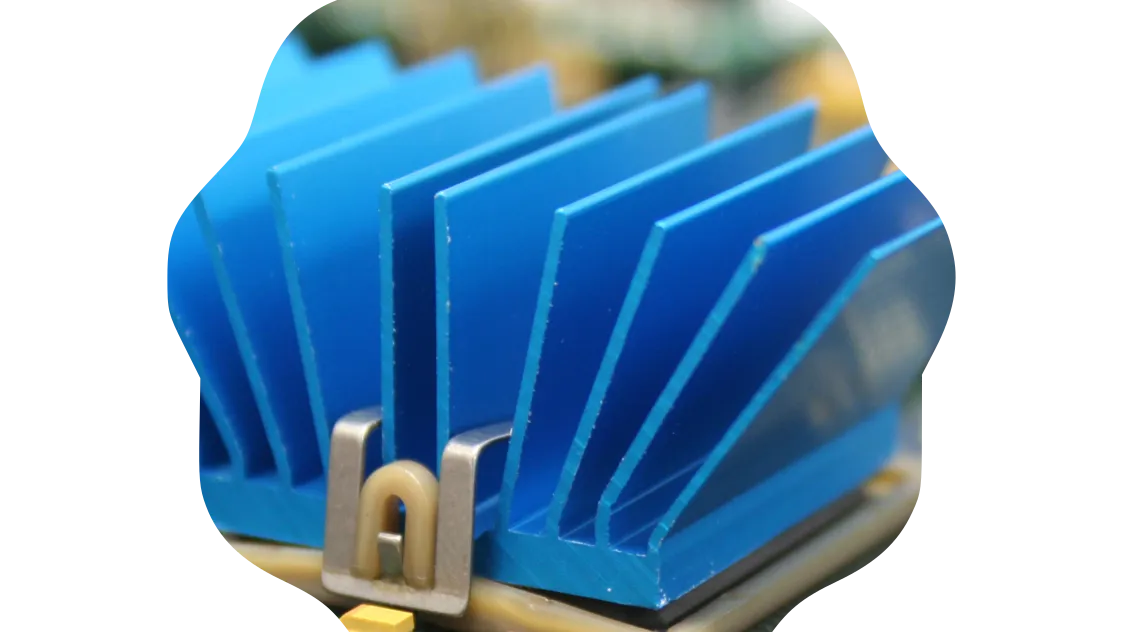
A heatsink is a passive heat exchanger that transfers heat generated by electronic or mechanical devices (like CPUs or GPUs) into a fluid medium—usually air—to prevent overheating. It works by absorbing heat through a metal base and dissipating it away through attached fins, which greatly increase the exposed surface area.
How it WorksHeatsinks rely on the basic principles of thermodynamics:
- Conduction: Heat transfers directly from the hot component into the flat base of the heatsink, which is made of a highly thermally conductive material like aluminum or copper.
- Convection: The heat moves up into the fin arrays. As surrounding air flows across these fins, it absorbs the thermal energy and carries it away from the device.
Common Types & Applications
- Active vs. Passive: Heatsinks by themselves are passive (no moving parts). However, they are frequently paired with cooling fans or liquid cooling pipes to accelerate heat removal.
- Computers: Commonly installed on processors (CPUs), graphics cards (GPUs), and solid-state drives (SSDs) to prevent throttling and hardware failure.
- Electronics: Used in power transistors, LEDs, and lasers.
Materials UsedHeatsinks are engineered using metals known for their high thermal conductivity:
- Aluminum: The most common material because it is lightweight, cost-effective, and easy to manufacture into complex fin shapes.
- Copper: Offers superior thermal conductivity compared to aluminum but is much heavier and more expensive. It is often used in high-performance or constrained spaces.